

Old Goa Churches Guide: Basilica of Bom Jesus, Sé Cathedral, Timings and Dress Code
What to see, when to go and how to understand a former capital instead of just photographing it.
Planning a visit to Old Goa? The Basilica of Bom Jesus and Sé Cathedral are two of Goa’s most famous landmarks, but they are only part of a much larger heritage landscape. From the atmospheric ruins of St. Augustine to the Church of Our Lady of the Rosary on Holy Hill, Old Goa rewards visitors who look beyond the most photographed monuments.
Once a major capital of the Portuguese empire in Asia, Old Goa was an important centre of trade, administration, religion and architecture. Today its surviving churches and convents offer a glimpse into a period that shaped Goa’s history and identity.
At Top Goa Tours, we believe Old Goa is best explored with a storyteller. A monument can be impressive on its own, but understanding why it was built, how the city developed and what happened to the wider settlement makes the visit far more meaningful.
Old Goa churches: a quick visitor guide
- Opening hours: churches usually open by about 10:30 a.m. and close by about 5 p.m. Plan your visit between these hours.
- Best-known landmarks: Basilica of Bom Jesus and Sé Cathedral.
- Worth exploring beyond the main sights: Church of St. Francis of Assisi, Church of St. Cajetan, Church of Our Lady of the Rosary, the Santa Monica complex and the ruins of St. Augustine.
- Time needed: around three to four hours at a relaxed pace.
- Time at each church: 20 to 30 minutes with a storyteller; a quick independent visit may take only 5 to 10 minutes.
- Getting there: self drive by car or two wheeler, or take a taxi.
- Walking: short walks between monuments, around 5 to 10 minutes between some churches from the parking area.
- Avoid: Saturday and Sunday Mass times (morning until about 10 or 10:30 a.m., evening from about 5 to 7 p.m.) and the days before the 3 December feast.
- Dress code: modest clothing suitable for a place of worship. Covering your shoulders and knees is a considerate choice.
- Accessibility: steps and uneven surfaces in places. Wheelchair access is limited and varies by monument.
Opening hours can differ by church, day, religious service and special occasion. Check the latest information before travelling, particularly if there is a specific church you do not want to miss.

Why is Old Goa called Old Goa?
One of the first questions visitors ask is simple: if this is Goa, why is it called Old Goa?
The name distinguishes the historic settlement from the later centres of administration and urban life that developed elsewhere in the region. Old Goa grew from an earlier settlement known as Ella and became an important Portuguese controlled capital after the conquest of Goa in 1510.
The city developed into a major centre of Portuguese administration, trade and religious activity. Churches, convents and other public buildings appeared across the settlement, reflecting the presence of different Catholic religious orders and the wealth and influence of the colonial administration.
Old Goa eventually declined as a centre of urban life. Disease, changing economic circumstances, environmental pressures and the movement of administrative activity elsewhere all contributed to its transformation. Much of the wider city disappeared or fell into ruin, while a number of its most important religious monuments survived.
This is why a visit can feel unusual. You see monumental churches standing amid a landscape that no longer resembles the bustling city they once belonged to.
The UNESCO listed Churches and Convents of Goa preserve an important part of this history. Inscribed in 1986, the heritage property recognises the monuments’ architectural significance and their influence on church architecture across Asia.
Why are there so many churches close to each other in Old Goa?
The concentration of churches is one of the most striking features of Old Goa. Several major monuments stand within a relatively small area, with more historic buildings and ruins a little farther away.
The reason lies in the city’s former role as a political, commercial and religious centre. Different Catholic religious orders, including the Jesuits, Franciscans, Dominicans, Augustinians and Carmelites, established a presence here. Each order had its own institutions, churches or convents, contributing to the dense collection of religious architecture.
These buildings also reflect the power and ambitions of Portuguese rule. Religion was central to the colonial project, alongside administration, maritime trade and the expansion of Portuguese influence in Asia.
It is important to understand both sides of this history. The churches are places of continuing faith and remarkable artistic achievement, but they also belong to a colonial period marked by political domination, religious pressure and profound changes to local society. Exploring Old Goa with this wider context helps explain why the monuments are here, and why their history is more complex than their beautiful façades suggest.
Why Old Goa is special: one of the few places where Goan churches are open to visit
Across Goa, many village churches are kept closed outside Mass and are hard to see inside as a visitor. Old Goa is the one area where you can walk into several major churches during the day, which is why it matters so much for anyone interested in Goan heritage. There is also a great deal to explore here, from monumental churches to quiet ruins and hillside sites.
Old Goa church timings and the best days to visit
Use these practical guidelines when planning your day. They come from our own experience of taking guests through Old Goa.
- Usual hours: the churches generally open by about 10:30 a.m. and close by about 5 p.m. Try to visit between these hours.
- Saturdays and Sundays: entry and access are limited when Mass is celebrated in the morning and the evening. The morning Mass runs until about 10 or 10:30 a.m. and the evening Mass is between about 5 and 7 p.m. Avoid these times for sightseeing.
- The feast of 3 December: the Old Goa feast is held on 3 December. About ten days before it, novenas begin. This is a very busy period and access for tourists is limited again.
- Crowds: the area tends to be busiest between about 10:30 a.m. and 1 p.m., so aim for the start of the opening window or the early afternoon if you want a quieter visit.
Hours can vary by church and by day, and some monuments close for services or conservation work. Do not assume every monument will be open just because a nearby church is. Confirm the latest information shortly before you travel rather than relying on an old itinerary or an unverified listing.
1. Basilica of Bom Jesus

The Basilica of Bom Jesus is probably the most recognisable church in Goa. Its historic façade, richly decorated interior and association with St. Francis Xavier draw visitors and pilgrims from around the world.
Construction was completed in 1605. It is notable for its architecture and for housing the tomb and relics of St. Francis Xavier, a missionary associated with the spread of Catholicism in Asia. The church was elevated to the status of a minor basilica in 1946.
What should you look for?
Take time to examine the exterior before heading straight inside. The façade combines architectural orders and is relatively restrained compared with some of the more elaborate church interiors in Goa. Inside, look at the main altar, the decoration and the mausoleum associated with St. Francis Xavier.
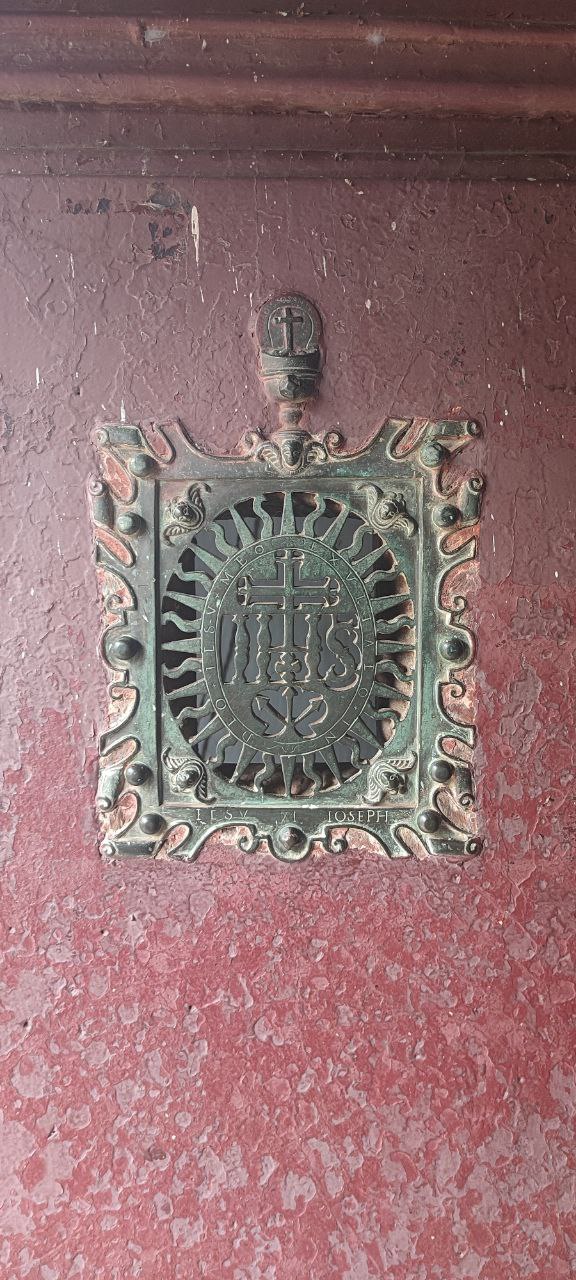
A storyteller can connect these visible details with the history of the Jesuits, the city’s religious institutions and the significance of the basilica beyond its status as a tourist attraction. Allow 20 to 30 minutes for a considered visit.
Visitor tip: this is an active place of worship. Be mindful of services, keep noise low and follow any photography restrictions.
2. Sé Cathedral and the story of the Golden Bell

Facing the historic square, Sé Cathedral is one of Old Goa’s most imposing monuments. Dedicated to St. Catherine of Alexandria, it commemorates the Portuguese victory associated with the conquest of Goa in 1510. Its scale is immediately striking, and the spacious interior rewards a closer look at the altars and decorative details.
The Golden Bell
One of the cathedral’s best known features is the Golden Bell, celebrated for the quality and distinctive character of its sound. It is a detail many visitors remember long after their visit, and a good example of how a small feature can open up a bigger conversation about craftsmanship, religious life and the reputation of the city.
Allow 20 to 30 minutes. Visitor tip: check service timings first, as access for sightseeing can be affected by Mass or special occasions.
3. Church of St. Francis of Assisi
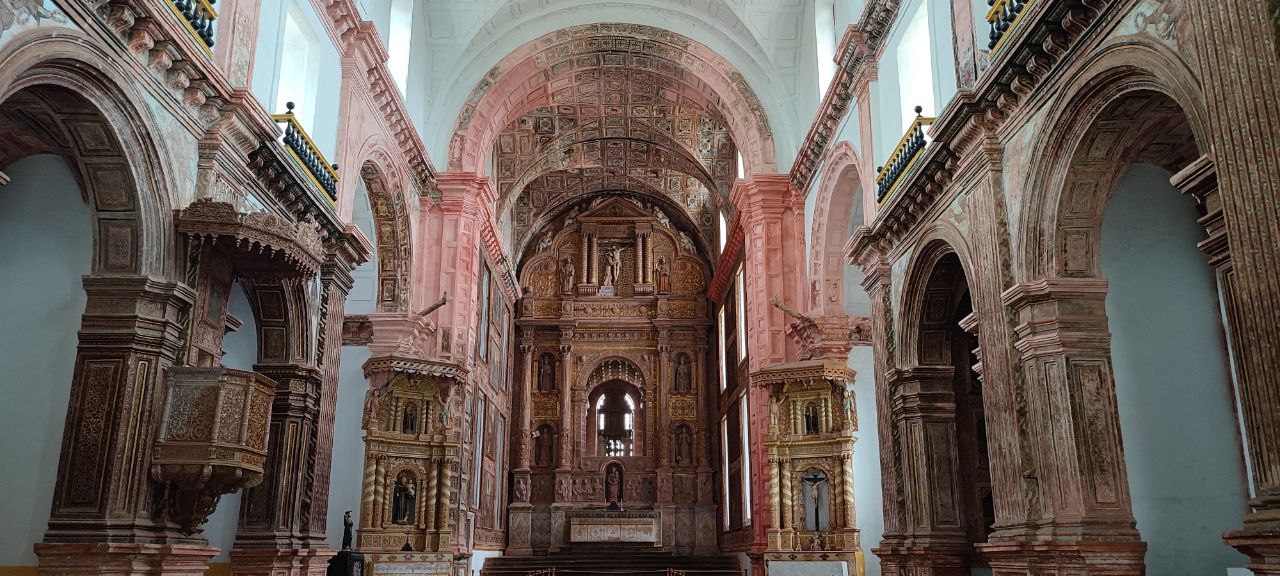
Close to Sé Cathedral, the Church of St. Francis of Assisi offers another perspective on Old Goa’s religious and architectural history. Its architecture and interior decoration differ from the cathedral and the Basilica of Bom Jesus. Old Goa’s churches are not repeated versions of one design. They reflect changing styles, different religious orders and distinct approaches to creating sacred spaces.
The adjoining former convent houses the Archaeological Museum, which can add another dimension to a visit, depending on current opening arrangements.
4. Church of St. Cajetan
The Church of St. Cajetan stands out for its architectural character. Its design is associated with St. Peter’s Basilica in Rome, making it an interesting stop for anyone curious about how European architectural ideas travelled to Goa. Instead of treating every church as a separate photo stop, compare how their façades, interiors, proportions and decorative styles differ. Allow 20 to 30 minutes and check current access.
5. Holy Hill: the side of Old Goa many visitors miss
Many sightseeing itineraries focus on the Basilica of Bom Jesus and Sé Cathedral before moving on. Holy Hill offers a different atmosphere, with historic religious sites that receive less attention from visitors on a quick route.
The ruins of St. Augustine
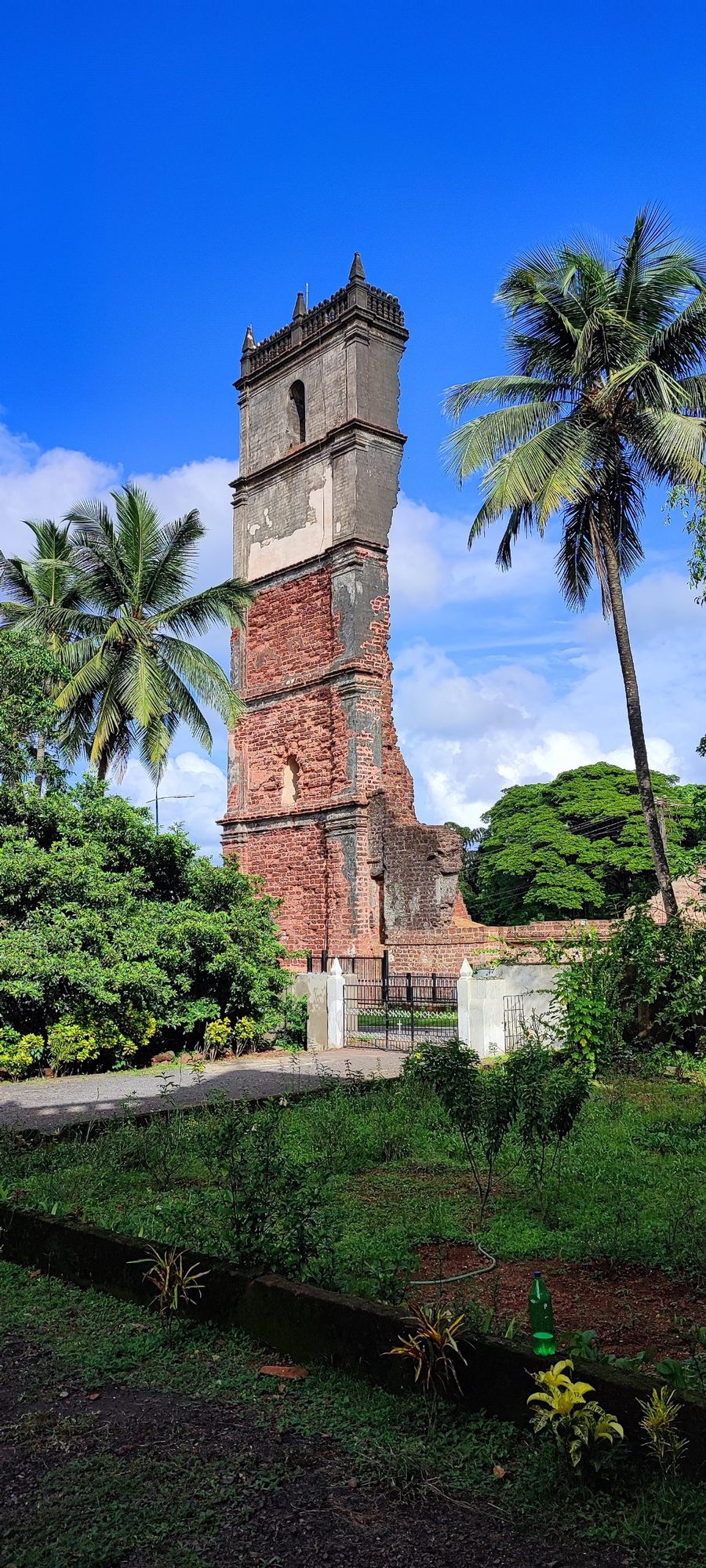
The ruins of the Church of St. Augustine are among the most evocative places in Old Goa. Once part of a much larger religious complex, the church fell into ruin and the surviving tower has become one of the area’s most recognisable remnants. You are looking at what remains of a building, and thinking about the scale of the complex that once stood here. Why did such a structure decline? What happened to the city around it? These questions make the ruins more than a photo stop.
The Church and Convent of Santa Monica
The Santa Monica complex is another worthwhile stop on Holy Hill. Its scale and architecture show another side of the religious institutions that developed in Old Goa, including convents that played an important role in the city’s religious life. Check current access before planning your visit.
Church of Our Lady of the Rosary
This church is rewarding for visitors interested in architecture and setting. Its position on the hillside offers a different perspective from the main church complex. The approach and surroundings are part of the experience, so take a moment to appreciate the view and the relationship between the church, the hillside and the landscape.
What is the history of Old Goa beyond its churches?
The churches are the most visible surviving landmarks, but they are only one part of the story. Before Old Goa became a Portuguese capital, the region was already connected to established networks of settlement, commerce and maritime exchange.
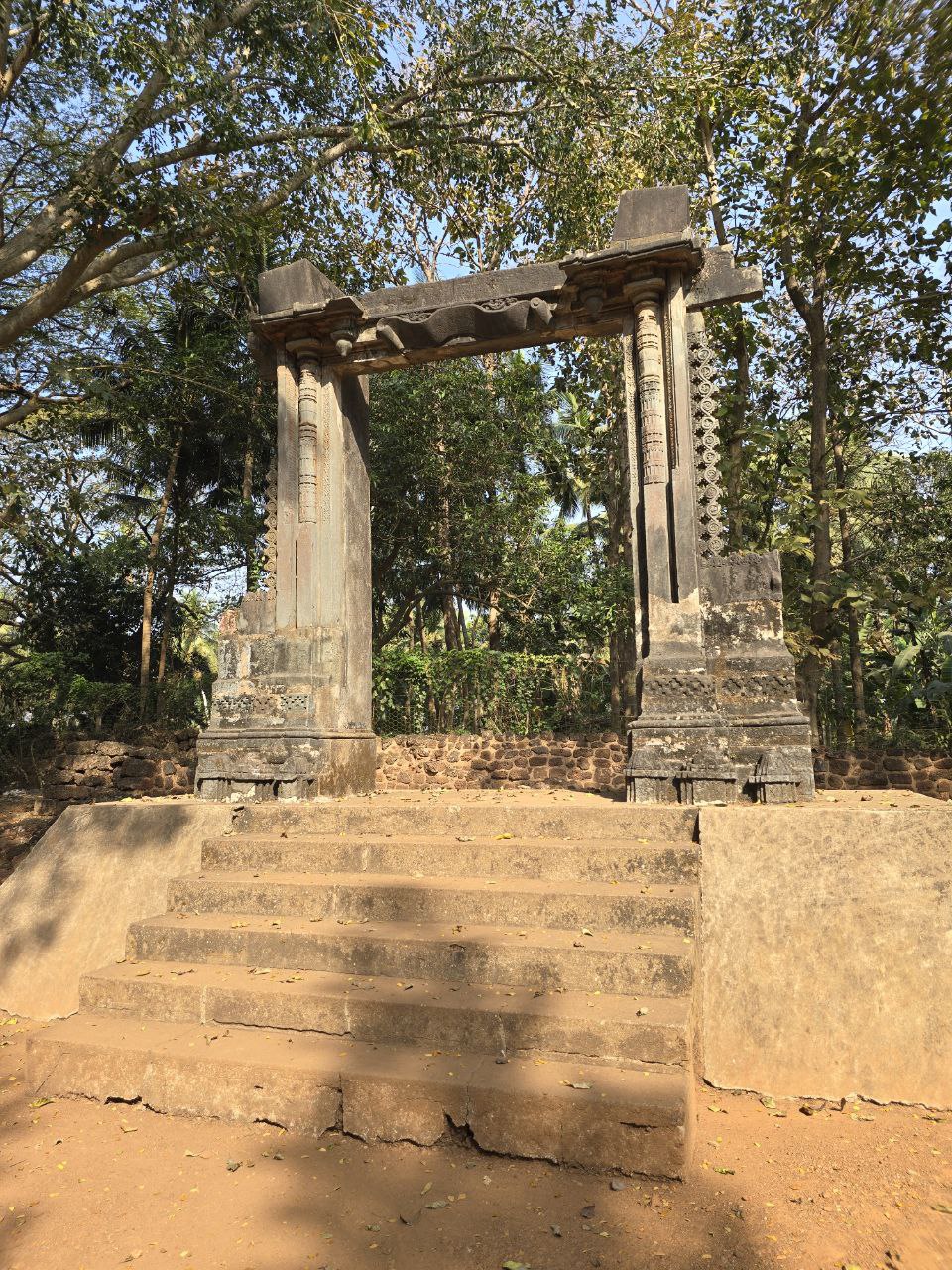
After the conquest of 1510, Goa became a major centre for Portuguese interests in Asia. Control of ports and trade routes was a significant part of Portuguese imperial strategy, and religious institutions developed alongside the colonial administration.
Old Goa was once a much larger urban settlement. Many of its former streets and secular buildings are no longer visible, which can make the surviving monuments seem isolated even though they once formed part of a living city. A good heritage walk connects these fragments and places the architecture within a balanced history, one that acknowledges devotion and artistic achievement alongside colonial rule and its consequences.
Is there a dress code for Old Goa churches?
Visitors should dress respectfully. Requirements may differ between sites, but modest clothing is a sensible choice.
- Cover your shoulders and knees where possible.
- Avoid beachwear or clothing that may be inappropriate for a place of worship.
- Carry a light scarf or cover up if needed.
- Keep your voice low inside the churches.
- Avoid disturbing people who are praying or attending services.
- Follow signs and instructions about photography.
How much time do you need to explore Old Goa?
For most visitors, three to four hours is a good starting point at a relaxed pace. A quick visit may cover only the Basilica of Bom Jesus and Sé Cathedral, which is fine if you are short on time but leaves much unexplored. With more time, add the Church of St. Francis of Assisi, St. Cajetan and the sites around Holy Hill.
The difference is not only the number of monuments. It is how much you understand. Exploring independently, visitors often spend five to ten minutes inside a church. With a storyteller, a single monument easily merits 20 to 30 minutes because the details, architecture and stories become easier to appreciate. If you want to understand Old Goa as a former capital, plan for a half day.
How do you reach Old Goa?
Old Goa can be reached by taxi or self drive, on a two wheeler or in a car. Once you arrive, expect to walk between monuments. Holy Hill adds more walking and may involve steps, slopes or uneven surfaces. Wear comfortable footwear, carry water and allow extra time for walking between sites.
Is Old Goa wheelchair accessible?
Accessibility varies by monument. Some approaches and interiors have steps or uneven surfaces, and wheelchair access is limited at several sites. If accessibility is a priority, confirm current conditions at the specific churches you plan to visit.
When is the best time to visit Old Goa?
Because the churches generally open by about 10:30 a.m. and close by about 5 p.m., the best window is inside those hours, outside weekend Mass times. The area is usually busiest between around 10:30 a.m. and 1 p.m. when tour groups arrive, so an early start within the opening window or a calmer weekday visit helps. Feast days can be meaningful if you want to see living traditions, but they are not ideal for a quiet architectural visit. The feast of 3 December and the novenas in the days before it bring large crowds and limited access.
What else can you visit near Old Goa?
- Panjim and Fontainhas: the historic Latin Quarter with its colourful streets and Portuguese influenced architecture.
- Chorão Island: a different side of Goa through its village landscape and nature.
- Divar Island: the quieter village character of the river islands.
- Mangeshi Temple: one of Goa’s important Hindu temples, adding another strand of the region’s cultural story.
You do not need to fit all of these into one day. Old Goa alone can fill a large part of the day when explored in depth.
Should you explore Old Goa on your own or with a storyteller?
You can certainly visit independently. The churches are visually impressive, and even a short visit gives a sense of their scale. But there is a difference between seeing a monument and understanding it. Without context it can be hard to know what to look for, why one church differs from another, how the religious orders shaped the area, or why the city once held such importance. The ruins can be especially hard to interpret when you cannot see the buildings that once surrounded them.
A storyteller helps connect these pieces. On a guided experience you can explore questions such as:
- How did the Portuguese arrive in Goa, and why did Old Goa become so important?
- What existed here before it became the capital?
- Why were so many churches and convents built close together?
- How do the architectural styles differ between the major monuments?
- What happened to the rest of the city?
- What do the ruins and surviving structures tell us about Old Goa’s former scale?
- How has conservation shaped the heritage site visitors see today?
Explore Old Goa with Top Goa Tours
Our heritage experiences are designed for visitors who want to understand the place they are exploring, not simply photograph it and move on. The Old Goa Heritage Walk brings the monuments and their stories together, and if you prefer your own pace and company, you can book a private Old Goa walk. For the broader picture, our Portuguese Goa experience, part of the TGT Curated Collection, covers the major part of Old Goa and goes further into Goa’s Portuguese heritage, so you see how the monuments fit into a wider story rather than only the famous churches.

Frequently asked questions about Old Goa churches
Which churches should I visit in Old Goa?
Start with the Basilica of Bom Jesus and Sé Cathedral, then consider the Church of St. Francis of Assisi and the Church of St. Cajetan. If time permits, explore Holy Hill, including the ruins of St. Augustine, the Santa Monica complex and the Church of Our Lady of the Rosary.
What are the Old Goa church timings?
The churches usually open by about 10:30 a.m. and close by about 5 p.m., so plan your visit between those hours. Access is limited during Mass, especially on Saturdays and Sundays, and during the build up to the December feast. Always check current timings before you travel.
How long does it take to visit Old Goa?
Allow around three to four hours to explore most of the major monuments at a relaxed pace. A shorter visit can cover the two best known churches, but a longer visit offers a fuller understanding of the historic city.
What is the dress code for Old Goa churches?
Wear modest clothing suitable for places of worship. Covering your shoulders and knees is a considerate choice, and you should follow any instructions displayed at individual churches.
Can I visit Old Goa without a guide?
Yes. You can explore independently, but historical context makes a real difference. A storyteller can explain the architecture, the role of the different religious orders, the rise and decline of the city, and the stories behind the monuments.
Why is the Basilica of Bom Jesus famous?
The Basilica of Bom Jesus is known for its architecture and for housing the tomb and relics of St. Francis Xavier. It is part of the UNESCO listed Churches and Convents of Goa.
What is special about Sé Cathedral?
Sé Cathedral is one of Old Goa’s most imposing churches. It is dedicated to St. Catherine of Alexandria and is associated with the famous Golden Bell.
Is Holy Hill worth visiting?
Yes. Holy Hill offers a chance to explore lesser visited parts of Old Goa, including the ruins of St. Augustine, the Santa Monica complex and the Church of Our Lady of the Rosary.
When is Old Goa busiest?
Weekend Mass times, the busy 10:30 a.m. to 1 p.m. window and the days around the feast on 3 December. About ten days before the feast, novenas begin and access for tourists becomes limited.
Is there an experience that covers more than Old Goa?
Yes. Our Portuguese Goa experience, part of the TGT Curated Collection, covers the major part of Old Goa and gives you a broader view of Goa’s Portuguese heritage.
Can I combine Old Goa with Panjim or Divar Island?
Yes. Panjim, Chorão Island, Divar Island and Mangeshi Temple can be added to a heritage focused day, depending on transport and time. Avoid fitting too many places into one itinerary.
Old Goa is more than a sightseeing stop
The Basilica of Bom Jesus and Sé Cathedral are excellent places to begin, but they are not the whole story. Give yourself time, look beyond the façades and ask why the city developed here, what made it important and how its rise and decline shaped the landscape that survives today.
Join the Old Goa Heritage WalkExplore Portuguese Goa (Curated Collection)